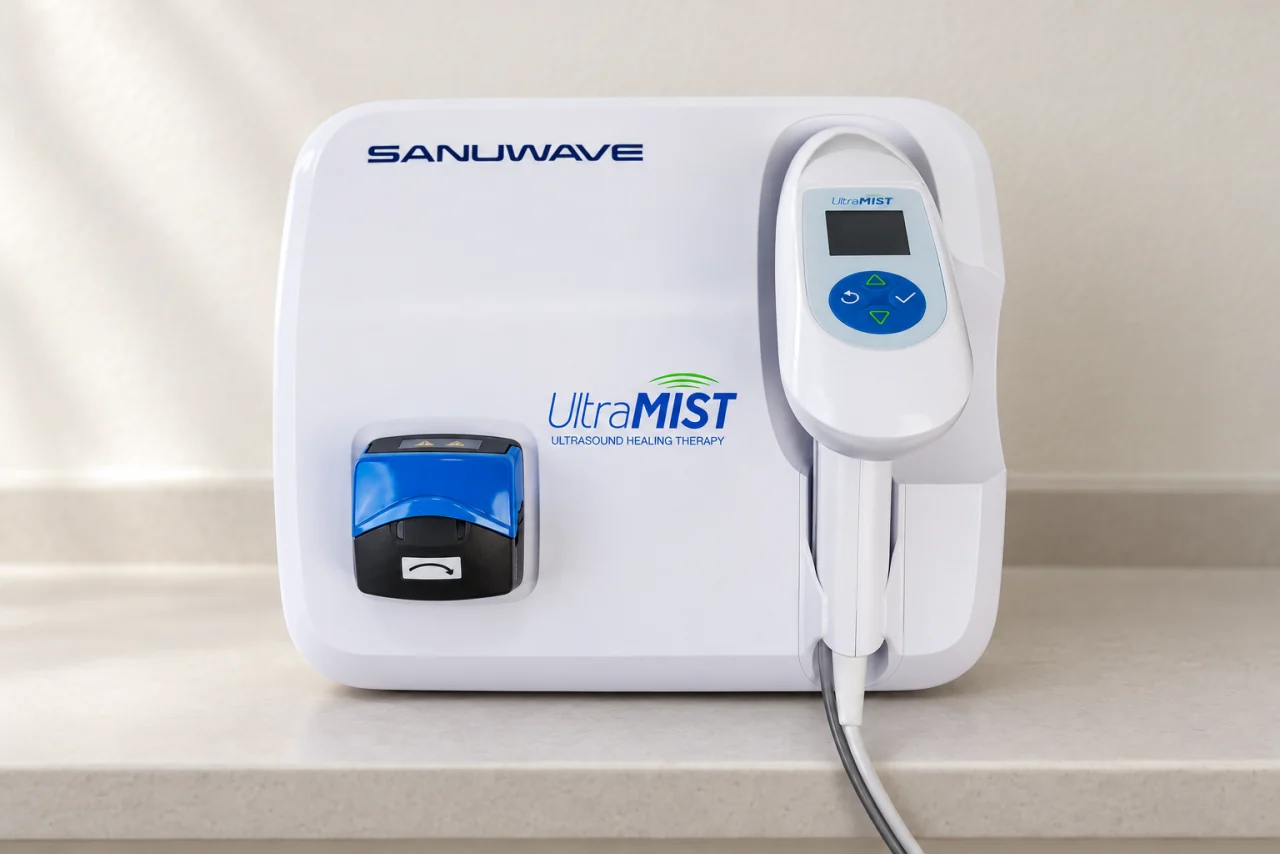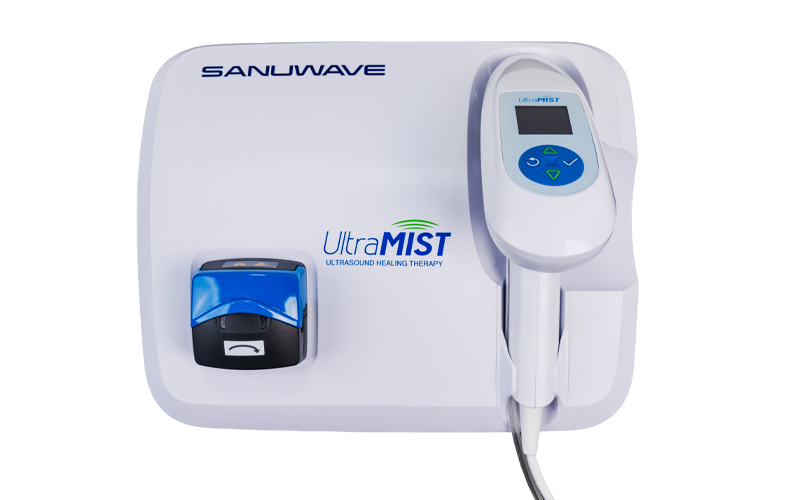
UltraMist® therapy.
An authorized retailer of Sanuwave UltraMist® — a clinically proven treatment that delivers low-energy, low-frequency ultrasound to the wound bed through a saline mist. Non-contact, painless, and supported by our full reimbursement and documentation infrastructure.
Acoustic energy, delivered through a saline mist.
Low-frequency (40 kHz), non-thermal, non-contact ultrasound. The acoustic waves mechanically stimulate cells in and below the wound surface, supporting the body's natural healing cascade in three measurable ways.
Decrease bacteria
Acoustic disruption reduces bacterial load and biofilm at the wound surface, lowering infection-related barriers to healing.
Decrease inflammation
Mechanical stimulation modulates the local inflammatory response, helping chronic wounds progress past the stalled inflammatory phase.
Increase perfusion
Improved blood flow and angiogenic signaling support granulation tissue formation and oxygen delivery to the wound bed.
Reference: Serena TE. Ostomy Wound Management. 2009;55(1):22–30. UltraMIST is an adjunctive treatment for acute and chronic wounds — including over exposed tendon, bone, arteries, veins, metal hardware, staples, and skin grafts. Contraindicated over cancer lesions, electrical implants (e.g., pacemakers), and the pregnant uterus.
Coding, eligibility, & documentation for medical necessity.
Everything billing and compliance teams need to support a clean CPT 97610 claim — drawn directly from Sanuwave’s 2025 reimbursement guide and Medicare LCD guidance.
Therapy & Coding
Eligibility — at least one required
Per Sanuwave’s reimbursement guide and Medicare LCD guidance, UltraMIST may be utilized when:
- No significant improvement after 30 days of standard wound care (SOC)
- Too painful for sharp or excisional debridement
- Contraindicated for sharp debridement — e.g., unstageable DTI, blood thinners, hemophilia, non-compliant patient
Per-session documentation
Each session should capture all five elements. A qualifying wound diagnosis is required.
- Pain level
- Wound measurements — length, width, depth, plus any undermining or tunneling
- Tissue appearance — granulation vs. necrotic tissue
- Inflammation / redness
- Drainage
Reassessment rule: Improvement in at least one of the five documentation elements must be evident by the 6th treatment to continue therapy under medical necessity.
CMS designates 97610 as a “sometimes therapy” code. Furnished under a therapy plan of care (POC), therapy modifiers may be required for MPFS payment; outside a POC, modifiers are typically not required for hospital outpatients. Consult your MAC or payer for state-specific LCD guidance.
Low-frequency ultrasound, delivered painlessly.
Non-contact acoustic energy that penetrates into and below the wound bed to stimulate cellular activity — without touching the surface.
Non-Contact & Painless
Because the ultrasound energy is delivered through a saline mist without touching the wound surface, patients experience no discomfort. Particularly appropriate for pain-sensitive wounds and patients who can't tolerate contact-based therapies.
Low-Frequency & Deep
The Sanuwave UltraMist system delivers ultrasound at 40 kHz through a non-contact fluid mechanism. Sound waves penetrate into and below the wound to stimulate the natural healing cascade at the cellular level.
Clinically Proven Outcomes
Proven to promote healing across venous leg ulcers, diabetic foot ulcers, deep tissue pressure injuries, surgical wounds, and soft tissue injuries. Integrates into existing visit schedules without workflow disruption.
What to know about UltraMist®.
Add UltraMist to your wound care program.
A 30-minute consultation to walk through device placement, reimbursement pathways, and clinical training.