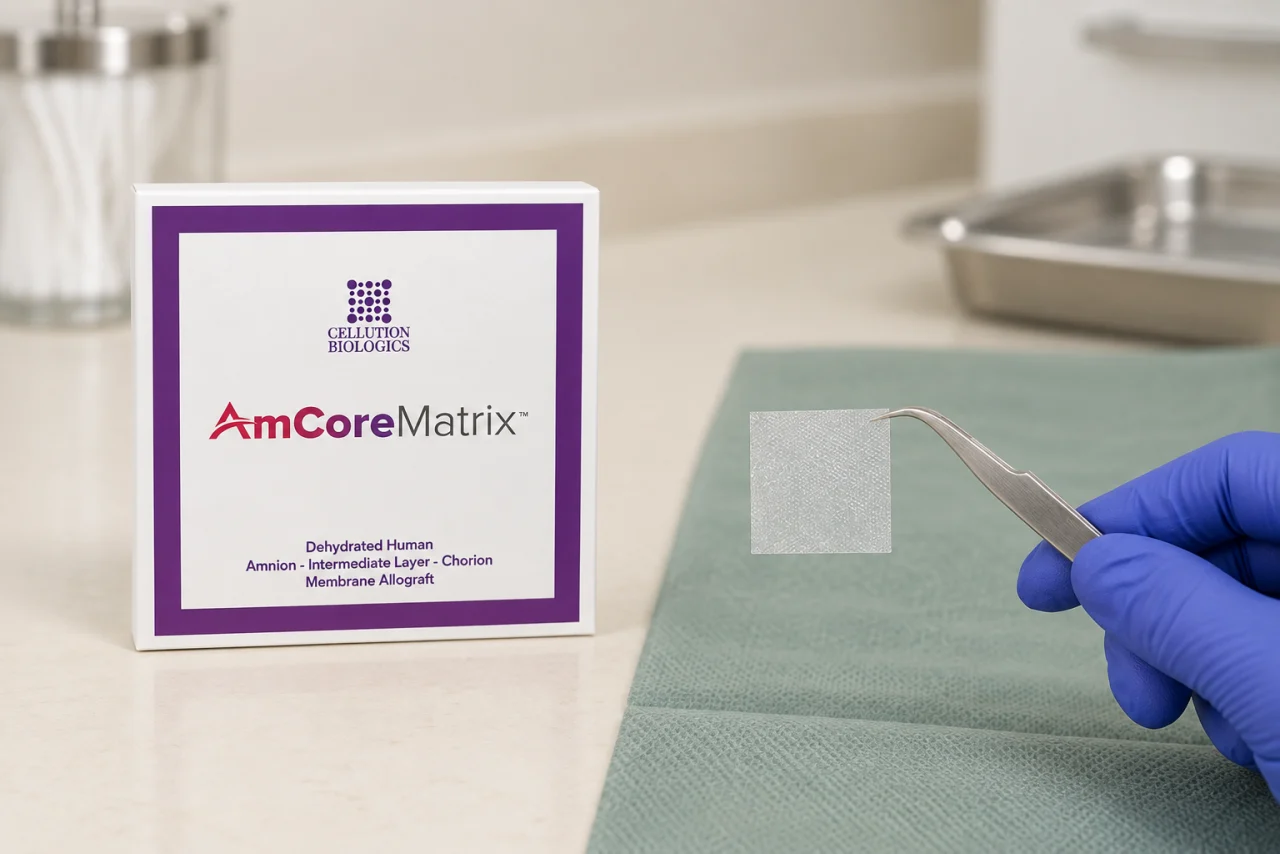
Adhesion Barrier. Dual-layer amniotic membrane
A chorion-free, dual-layer amniotic membrane allograft for open, laparoscopic, and robotic procedures — in partnership with Total Surgical. Deploys through a standard 10–12 mm trocar, handles simpler than MiMedx or Integra alternatives, and may reduce post-operative adhesions while facilitating healing.
Adhesions — the hidden tax on every abdominal case.
Post-operative adhesions are the leading cause of chronic pelvic pain, secondary infertility, small bowel obstruction, and reoperation complications. MIS reduces the rate — but does not eliminate it.
55–93%
of intra-abdominal surgeries form post-operative adhesions across published pelvic and abdominal MIS literature. Every case is a candidate for a barrier conversation.
Four clinical tolls
Chronic pelvic pain. Secondary infertility. Small bowel obstruction. Reoperation. The cost is carried by the patient and by the system — long after the OR lights come down.
3–5 added minutes
At closure. No new instruments. No change to docking or port placement. No learning curve for scrub or circulator. A barrier program adopted now runs uninterrupted.
References: Diamond & Freeman 2001; Trew 2004; Brill et al. 2011. Published incidence ranges reflect pelvic and general MIS literature.
Four mechanisms. One tissue.
Synthetic barriers are passive. Amniotic membrane is doing four things at once inside the 5–7 day adhesion-formation window.
Physical barrier
Smooth epithelial surface separates healing peritoneum from adjacent structures during the critical 5–7 day adhesion-formation window.
Anti-inflammatory signaling
Native cytokines — TGF-β, IL-10, MMP inhibitors — actively modulate the fibrotic cascade instead of just blocking it.
ECM scaffold
Collagen IV, V, VII and hyaluronic acid support healing toward normal tissue, not scar. Growth factors (EGF, VEGF, TGF-α, IGF-1) drive re-epithelialization.
Fully resorbable
No foreign-body reaction. No second surgery. No lifelong implant. Contains no Class II antigens — immune-privileged, reducing the risk of patient reaction.
Your team places the second sheet as comfortably as the first.
No new instruments. No change to docking or port placement. No learning curve for scrub or circulator.
Select size
Pre-cut sheets sized for common applications — 4×4, 4×6, 4×8, 6×6 cm — or trim to field. Additional sizes available on request.
Hydrate
Saline bath, 30–60 seconds, while finishing the procedure. No dry-field requirement — unlike Interceed.
Deploy through trocar
Roll and pass through a standard 10–12 mm trocar. Thin, pliable, chorion-free membrane fits where bulkier allografts from MiMedx and Integra don’t.
Position & secure
Standard laparoscopic graspers. Conforms to tissue and stays put. Suture-less placement. Added case time: 3–5 minutes at closure.
The Trocar Advantage
Thinner. Pliable. Fits where others don’t.
In laparoscopy specifically, every millimeter matters. A dual-layer, chorion-free membrane rolls smaller and passes through a standard port without fighting the sleeve — a handling reality that surgeons immediately feel versus the bulkier placental allograft category.
Handling vs. alternatives
Why this category wins in MIS
Only one product does regenerative work in addition to barrier function. Seprafilm and Interceed are passive. PTFE is permanent. Dermal-matrix products are shaped for open reconstruction, not robotic ports.
- Barrier & activeAmniotic membrane is barrier + anti-inflammatory + ECM scaffold — the others are barrier only.
- Fully resorbableUnlike PTFE, leaves nothing behind. No reoperation, no lifelong implant, no foreign-body reaction.
- Wet-field readyNo dry-field requirement. Hydrates in saline while you finish the closure. Interceed can’t do this.
- Trocar-shapedRolls and passes through a standard 10–12 mm port. Category alternatives are bulkier or open-only.
- Suture-lessConforms to peritoneum and adjacent tissue. No fixation step, no added OR time beyond placement.
- Room-temp storageAmbient storage in the OR core. No freezer, no thaw, no inventory headaches.
Workflow-neutral by design. No new instruments, no scrub re-training, no change to docking or port placement. The second sheet places as comfortably as the first.
Every abdominal & pelvic specialty. Every abdominal wall.
Allograft Tissue can be used in open incision, laparoscopy, and robotic surgery — including the da Vinci platform — wherever tissue separation and regenerative barrier function are indicated.
Urogynecology & gyn MIS
Hysterectomy. Oophorectomy. Myomectomy. Endometriosis excision. Highest adhesion rate in gyn — particularly for fertility-preserving myomectomy and deep endometriosis excision cases.
Colorectal surgery
Exploratory laparotomy with bowel resection. Lower anterior resection (LAR). Partial, hemi-, and total colectomy. Protects anastomoses and adjacent bowel during the adhesion-formation window.
Urologic reconstruction
Radical prostatectomy — open, laparoscopic, or robotic. Protects the neurovascular bundle and nearby structures during healing while minimizing post-operative fibrotic tethering.
Vascular & access
FEMPOP bypass. AV fistula creation. Vascular anastomosis. Reduces inflammatory tethering at anastomosis sites and may support patency through active ECM signaling.
Indications and procedure-specific use are at the discretion of the operating surgeon. Additional specialties — including surgical oncology, hepatobiliary, and hernia repair — have reported clinical use of amniotic membrane allografts for adhesion prevention and soft-tissue coverage.
Resorbable & chorion-free amniotic membrane allograft.
Sourced from healthy, pre-screened, consenting mothers during planned, full-term Caesarean sections. Processed in the United States in accordance with AATB and FDA rules, regulations, and standards.
Specifications
Available sizes
Four standard configurations — pre-cut for common laparoscopic and open applications. Additional sizes available on request.
- C204044 × 4 cm — port-site coverage, focal adhesion prevention
- C204064 × 6 cm — myomectomy bed, adnexal protection
- C204084 × 8 cm — sacrocolpopexy, endo excision, wider coverage
- C206066 × 6 cm — hysterectomy cuff, colorectal anastomosis, prostatectomy bed
Benefits at a glance
- May reduce adhesionsPhysical separation + active anti-fibrotic signaling during the 5–7 day formation window
- May reduce scarringCollagen IV/V/VII and hyaluronic-acid scaffold support healing toward normal tissue
- May decrease inflammationNative cytokines modulate the fibrotic cascade — not just a passive block
- May facilitate healingGrowth factors and rich ECM drive re-epithelialization and regenerative repair
- Low reaction riskNo Class II antigens — immune-privileged tissue, reducing patient reaction
- Multiple pathwaysOpen incision, laparoscopy, and robotic — one product across your full case mix
HCPCS C1762 — transitional pass-through.
Reimbursed under OPPS / ASC pass-through — in addition to the facility fee for the procedure. The surgeon bills their usual CPT. The patient pays nothing.
Coding & Coverage
Three-party economics
Every stakeholder wins — which is why adoption sticks once it starts.
- The facilityBills C1762 separately under OPPS/ASC pass-through — facility margin on every case
- The surgeonZero coding change. Your CPT workflow stays identical — hysterectomy, myomectomy, prostatectomy, LAR
- The patientNo financial conversation required. Not cash-pay. Not out-of-network. No surprise bill
Example commonly-paired CPTs
- 58545 / 58546Laparoscopic myomectomy (± robotic)
- 58571 / 58573Total laparoscopic hysterectomy (≤ 250 g / > 250 g)
- 57425Laparoscopic sacrocolpopexy
- 58662Laparoscopic excision of pelvic lesions (endometriosis)
- 55866Laparoscopic radical prostatectomy
- 44140 / 44204Colectomy · laparoscopic partial colectomy
Workflow-neutral, reimbursement-paid. The facility is made whole on every sheet, the surgeon bills their usual CPT, and the patient has zero out-of-pocket exposure. Our team walks your facility billing contact through the C1762 mechanics end-to-end before the first case.
C1762 pass-through status, payment, and coverage are determined by CMS and subject to change. Coverage and payment ultimately depend on payer policy and medical necessity. Our team confirms current pass-through status and works with your facility billing contact on a case-specific basis.
What to know about our adhesion barrier.
Add regenerative adhesion prevention to your OR.
A 30-minute consultation to walk through billing mechanics, OR in-service scheduling, and a low-friction pilot pathway that fits your case mix.